Is chest pain normal after exercise? Experts teach you how to identify and relieve it

Do you experience chest soreness, fullness, or even a slight tingling sensation after high-intensity training? This is common, but it shouldn’t be ignored. It’s usually a sign that you need better support and recovery.
You need to choose a suitable sports bra that not only helps stabilize your breasts and reduce strain but also protects your mammary glands and pectoral muscles. Combined with post-workout stretching and recovery, it makes exercise safer and more comfortable while reducing the risk of sports injuries.
Chest pain after exercise: is it “exertion” or “problem”?
Have you ever experienced this? After a workout, you’re sweating profusely, your muscles are sore and comfortable, but that dull ache in your chest makes you frown?
Especially for women, this pain can be confusing: is it a sign that your exercise is working, or is it your body telling you something’s wrong?
Actually, breast soreness after exercise isn’t necessarily a bad thing. It could be a natural reaction to minor muscle damage, or it could be due to insufficient support, unsuitable underwear, or even related to your menstrual cycle or breast health.
The key is to learn to “understand” your body’s language.
Why do you get chest pain after exercise? 4 common reasons explained
1. Not enough support—the underwear is “lazy.”
When you run, do aerobics, or lift weights, your breasts vibrate repeatedly with the movement. Without proper support, this can strain the mammary glands and connective tissue, leading to soreness over time.
This strain is particularly pronounced in women with larger busts.
The solution: Choose a sports bra with strong support.A one-piece back design evenly distributes vibrations, while wide shoulder straps reduce shoulder and neck pressure. It’s also breathable and prevents stuffiness, making it ideal for high-intensity exercise.
2. Excessive exercise or improper posture
If you’ve recently increased your training intensity, perhaps switching from brisk walking to HIIT or from yoga to weight training, you may have overstretched your upper chest muscles (especially the pectoralis major).
This is common “delayed onset muscle soreness,” a normal reaction, but it also suggests you should proceed gradually . For a more stable recovery,
apply a hot towel for 10 minutes after your workout to increase circulation.
3. Menstrual period or hormone fluctuations
Many women experience increased breast sensitivity around menstruation due to hormonal changes.
Strenuous exercise during this period can increase the risk of breast pain.
It’s recommended to opt for low -impact exercise and a comfortable bra during menstruation , such as a wire-free sports bra with memory foam , to reduce pressure.
4. Mastitis or other health problems
If the pain lasts for a long time and is accompanied by redness, swelling, fever, or a localized lump, it’s not caused by ordinary exercise, but may be mastitis or cystic lesions.
In this case, seek medical attention as soon as possible. Don’t delay.
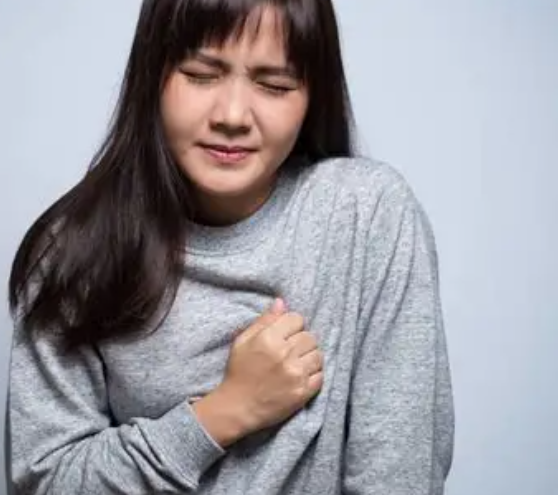
How to distinguish between “normal soreness” and “abnormal pain”?
Want to know if you should be worried? Here’s a three-step self-check:
① Pain duration
Normal pain: gradually relieved within 1-3 days;
Abnormal pain: remains obvious for more than 5 days or becomes increasingly severe.
② Pain location
Normal soreness: mostly concentrated around the pectoralis major muscle;
Abnormal pain: concentrated in the nipple or inside one breast.
③ Associated symptoms
Normal soreness: no redness, swelling or fever;
Abnormal pain: nipple discharge, skin dimpling, obvious lumps, etc.
If you fall into the second category, please don’t hesitate to go to the hospital for a breast ultrasound. Safety is the most important thing.
Experts teach you: How to relieve chest pain after exercise?
1. Use heat to help blood circulation
Apply heat for 10 minutes within 2 hours after exercise to relax the chest muscles and breast tissue.
You can use a towel or hot water bottle, but be careful not to overheat.
2. Gentle massage
Gently massage upward in circles with your palms from the underside of your breasts for 3-5 minutes each time. This can help unclog the breasts and accelerate metabolism.
Avoid excessive force, and avoid using topical products containing ointments.
3. Improve training intensity and sequence
Plan chest training on moderate-intensity days , and make sure to warm up and stretch before and after.
Afterward, gently use the roller to loosen up your shoulder and chest muscles.
4. Wear the right sports bra
A good sports bra is the first line of defense for breast protection. The plus size racerback cutout sports bra , for example , not only provides ample support, but its hollow structure also helps dissipate heat, preventing dampness and discomfort that can lead to breast discomfort.
For women with fuller breasts, this I-back design provides stability and prevents movement, preventing secondary strain from bouncing around.
5. Replenish protein and water after exercise
Pectoralis major muscle soreness is also related to lactic acid accumulation. Consuming protein powder, eggs, or milk can help with muscle recovery. Don’t forget to drink plenty of water to boost your metabolism.

Will wearing a sports bra that is too tight affect the breasts?
This is a question that many people worry about.
The answer is: short-term tight support will not harm the breasts, but long-term compression and wearing the wrong size can cause problems.
If your bra is too tight, you may experience the following:
The mammary ducts are compressed, resulting in poor lymphatic circulation;
Painful or irritated nipples caused by friction;
It may even cause chest tightness and difficulty breathing.
So, when choosing a sports bra, pay attention to:
Support does not mean tightness. It should fit you well without leaving any marks.
The material is breathable, reducing stuffiness and friction;
The shoulder straps are wide and stable, especially the I-back style, which can distribute the pressure more evenly.
You can raise your hands and take a deep breath when trying them on to ensure that your chest is still stretched.
A truly good sports bra should make you forget it’s there, rather than constantly reminding you that “I’m squeezing you.”
Summary: Listening to your body is the smartest way to train
Exercise should make us stronger and more confident, not cause new pain.
Chest soreness isn’t a sign of a good workout; it’s a signal from your body.
When you learn to distinguish between healthy soreness and abnormal pain and take appropriate care of yourself, your training will be easier and more reassuring.
So, next time before you exercise, ask yourself, “Is my bra ready?#8221;
A well-fitting plus size racerback cutout sports bra may be the first step to help you move from “chest pain” to “physical and mental relaxation.”