The ultimate test of support and comfort for long-distance runners’ sports bras

In the morning mist, runners tighten their shoelaces, and the stable fit around their chests often determines whether the next 42 kilometers will be a smooth or arduous journey. The sports bra, seemingly simple, is the most hidden yet crucial “equipment technology” for marathon runners. It’s not just about support; it’s a subtle balancing force between body and mind on the endurance track.
For long-distance support, the challenge lies not only in controlling vibrations during sustained running but also in pushing the comfort limits under the combined effects of muscle fatigue, sweat friction, and temperature changes. This is why every female runner is looking for the ideal running sports bra that allows her to “forget it’s there” when choosing one.
Stable support: Maintaining precise balance over 42 kilometers
As the body enters a long-distance rhythm, the vertical and horizontal vibrations of the chest accumulate over thousands of strides. Studies show that during a marathon, the average breast movement can reach 9 centimeters. This repeated vibration not only affects running form but also leads to muscle fatigue and skin strain. A high-performance sports bra must find a precise balance between compression and encapsulation support.
The compression design is suitable for runners with smaller chests, providing a lightweight, snug fit and reducing friction from excess material, while the enclosed structure provides independent zone support for runners with medium to large chests, keeping them stable without being overly constricted with each step. Professional marathon bras often combine both mechanisms, adding a mesh reinforcement support layer in key areas to ensure elasticity and breathability even at long-distance running pace.
In a 2024 Boston Marathon data survey, more than 78% of female runners said that support stability directly affects their finishing performance—a “passively fitted” bra can help you maintain your rhythm during the 35 km hit-the-wall phase, instead of being slowed down by discomfort.

Breathable and skin-friendly: A second skin for long distances
The enemy of long-distance running is never speed, but constant friction and humidity. Imagine that after the first hour of running, sweat mixed with salt forms microcrystals on your skin, and every friction between your clothing and skin can become a sore spot.
Running sports bras is key to combating all of this. Top sports brands are using “microporous fiber weaving technology,” which controls the density in different areas to give high-heat zones (such as the under-chest and back) greater sweat-wicking capacity. This allows runners to maintain a dry feel even in high-humidity environments, avoiding the “salt stinging” sensation.
Furthermore, a close-fitting cut and seamless edges have become standard in long-distance designs. Compared to traditional seamed bras, the seamless one-piece structure can reduce the probability of skin friction by nearly 60%. Meanwhile, the X-shaped shoulder straps or U-shaped support at the back balance pressure distribution on the shoulders and neck, allowing for a more natural and relaxed running posture.
Endurance and Recovery: The Hidden Engineering of Sports Bras
Many people believe that sports bras are only important during running, but they also affect the body’s recovery after long-distance training. The mammary glands and upper pectoral muscles need to be “stabilized and memorized” during high-frequency vibrations, and highly elastic recovery materials can form a “dynamic buffer” during support, reducing tissue fatigue.
Some marathon bras feature a multi-layer composite material design: a soft, skin-friendly inner layer, a highly elastic support middle layer, and an outer layer covered with quick-drying mesh. This design provides stability during running and helps dissipate heat quickly after training, reducing the burden on the skin.
According to an industry report by Running Insight, a three-layer sports bra loses only 42% of its support after six months of continuous use. This means that for endurance runners who train more than five times a week, a high-quality bra not only improves running feel but also prolongs the long-term health of muscle tissue.
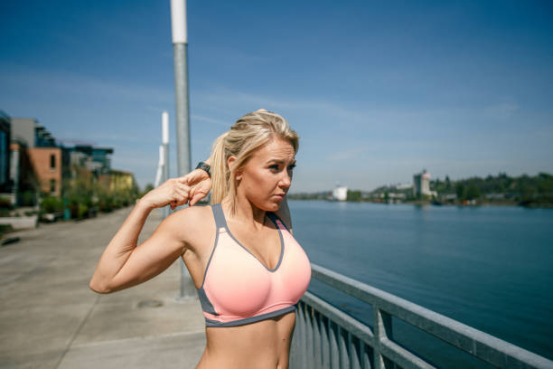
From technology to psychology: Supporting more than just the body
Runners often say that a marathon is a psychological battle. Support exists not only in muscles but also in willpower. A sports bra that truly understands you is like a metaphor for security during long runs—you can completely trust it without looking back or needing adjustments.
Industry trends indicate that future running sports bras will move towards a “smart fit.” New materials, such as “temperature-responsive memory fibers,” will automatically adjust support intensity at different stages, while AI measurement systems can record running vibration data via a mobile app, providing personalized support solutions.
This is not just a technological iteration but also a design philosophy of “mind-body alignment.” For professional runners, this predictable comfort is the fuel for “mental endurance.”
Your next kilometer begins with support.
Long-distance running is never just a simple endurance test but a symphony of body and equipment. A great sports bra not only lets you run longer but also gives you more freedom.
If you’re preparing for your next half or full marathon, consider re-evaluating your support system—not by asking, “Is it tight enough?#8221; but by asking, “Can it make you forget it’s there?#8221;